Industrial Parks Ethiopia Incentives: What You Actually Get
30 July 2026 · 5 min read
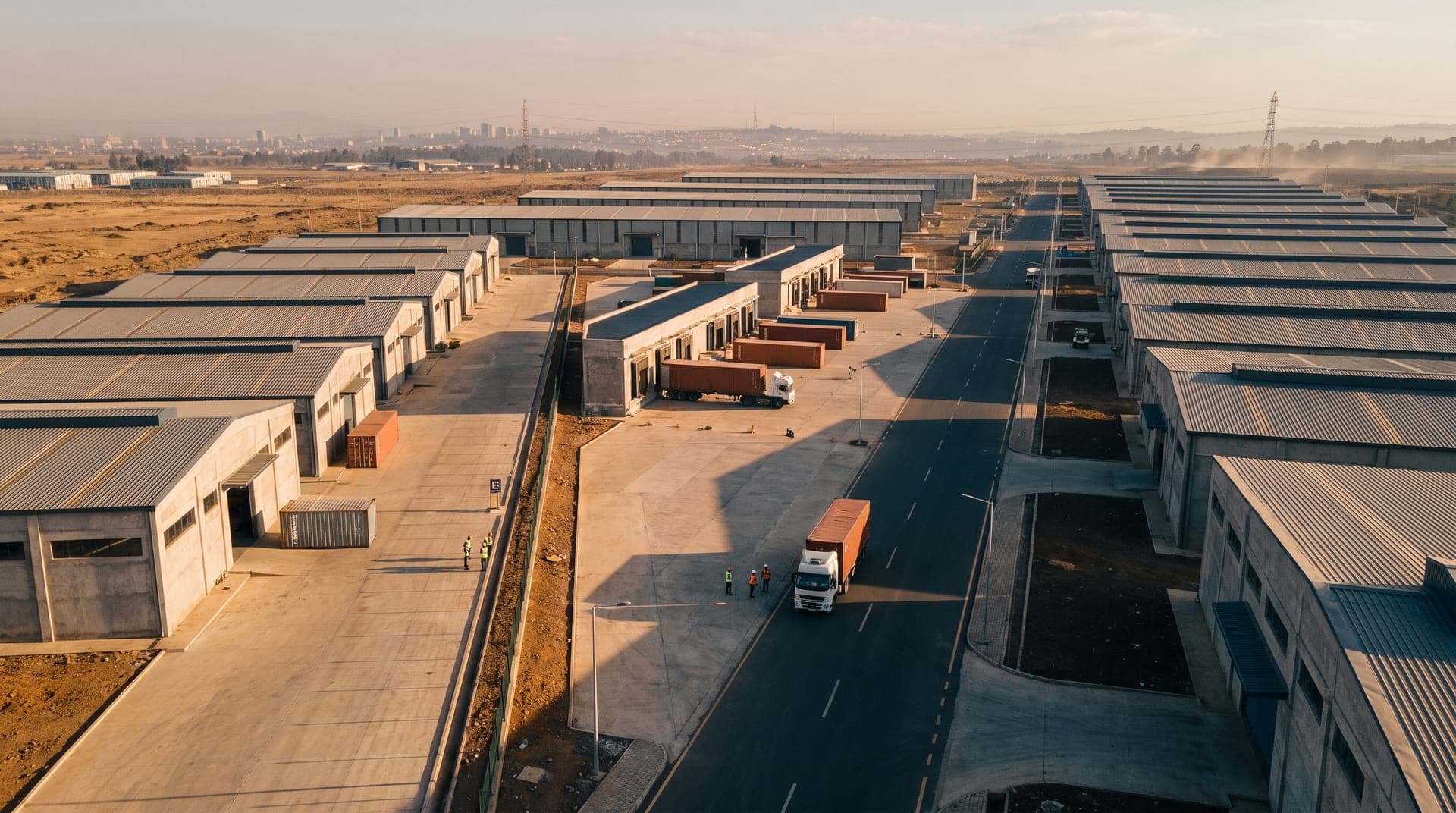
The core incentives for industrial parks in Ethiopia—featuring corporate income tax exemptions and duty-free import of capital goods—are not blanket guarantees. They are strictly conditional on two factors: the proportion of your production that is exported, and the geographic location of the park you choose.
Foreign investors evaluating Ethiopia often read the headline incentives and build financial models assuming extended periods of zero taxes. The reality on the ground requires a sharper understanding of how the Ethiopian Investment Commission (EIC), the Industrial Parks Development Corporation (IPDC), and the Ethiopian Customs Commission actually apply these rules.
The Landlord vs. The Regulator
To operate in an IPDC-managed industrial park, you deal with two distinct state entities. (It is critical to note that governance and leasing structures in regional state-owned parks and privately developed parks will differ.)
The IPDC is your landlord. They build the sheds, maintain the perimeter, and manage the utility connections. You sign your lease with them.
The EIC is the regulator. They issue your investment licence, process your work permits, and legally grant the incentives. The EIC operates a "One-Stop Shop" directly inside the major parks, established to handle routine regulatory filings on-site. To ensure this translates into actual speed, you must ask the EIC: precisely which permits and clearances bypass a trip to the capital, and which still require headquarters approval?
The Corporate Income Tax Holiday: How the Math Works
Corporate income tax in Ethiopia is assessed at a standard rate defined by the Ministry of Revenues; this baseline must be validated when building your financial model. The tax holiday granted to park tenants is designed to push industrialisation outside of the capital and drive foreign exchange generation.
Your exemption period depends on distance from Addis Ababa and your sector. To qualify for the maximum bracket under the investment incentive schedule issued by the Council of Ministers, your production must meet a strict minimum export threshold.
- Addis Ababa & Surrounding (e.g., Bole Lemi): Shorter baseline tax exemption periods apply due to proximity to the capital.
- Regional Parks (e.g., Hawassa, Mekelle, Kombolcha): These locations offer extended tax exemption periods, with some specialised agro-processing sectors eligible for an additional maximum term.
The exact export thresholds and duration lengths are set by the EIC and should be confirmed before they are budgeted or relied on.
If you pivot your strategy to sell more than your permitted non-export allowance into the local Ethiopian market, you breach the primary condition of the export incentive. You will be required to pay the standard corporate tax rate on domestic sales, and you may retroactively owe customs duties on the imported raw materials used to manufacture those local goods.
Duty-Free Imports: Capital Goods vs. Raw Materials
The most immediate financial benefit of park entry is the duty-free import scheme. However, capital goods and raw materials are treated differently.
Capital Goods
Machinery, equipment, and construction materials required to establish your factory are designated as duty-free. However, before shipping, you must ask the EIC and the Customs Commission: exactly which asset classes qualify under your specific manufacturing profile? Once verified, you submit your approved master list to the EIC, and the Customs Commission honours it.
Raw Materials
Raw materials used for export production are also exempt from import duties, but they are administered through a voucher scheme or bonded manufacturing warehouse system. You must prove that the raw material entering Djibouti eventually left the country as a finished product. If a local customs audit reveals a discrepancy between imported raw materials and exported finished goods (allowing for standard manufacturing waste), you will be taxed on the difference.
Infrastructure: The Real Incentive
Tax holidays are valuable, but for operational contractors and manufacturers, the true incentive of an Ethiopian industrial park is infrastructure reliability.
Operating outside a park means negotiating directly with the Ethiopian Electric Power (EEP) for grid access, digging your own boreholes, and building your own security perimeter. Inside a park like Hawassa, sheds come pre-connected to dedicated substations, centralised zero-liquid-discharge (ZLD) effluent treatment plants, and standardised water infrastructure. The premium you pay in rent directly offsets capital expenditure (CapEx) and minimises operational delays.
Repatriation and Forex Priorities
Ethiopia exercises tight capital controls through the National Bank of Ethiopia (NBE). Repatriating profits requires foreign exchange. Industrial park tenants who are net exporters are permitted to retain a proportion of their foreign exchange earnings in local forex accounts based on NBE directives. Rather than assuming uninterrupted liquidity, you must ask the NBE: what is the current permissible retention ratio, and do dividend repatriations or raw material imports genuinely bypass standard commercial bank forex queues today?
The Sequence of Execution
If you are evaluating market entry, the sequence matters:
- Assess: Model your actual export-to-domestic ratio. Do not model an extended tax holiday if your primary target is the local Ethiopian market.
- Establish: Sign the Memorandum of Understanding (MoU) with the IPDC for shed allocation before importing capital goods. The duty-free master list cannot be approved until your park presence is formalised.
- Execute: Utilise the on-site EIC One-Stop Shop for immediate visa and customs clearance, but maintain rigorous internal audits of your raw material imports to satisfy future customs inspections.
Understanding the conditions attached to Ethiopia's incentives is the difference between a stalled project and a profitable operation. To protect your margins, designate a dedicated compliance officer to reconcile your raw material import vouchers against your finished export goods prior to each local customs audit; retroactively failing this reconciliation is the most common way foreign manufacturers inadvertently forfeit their financial advantages.
Questions this raises
- How long is the tax holiday in Ethiopian industrial parks?
- The duration of the tax holiday depends primarily on the park's distance from Addis Ababa and whether you export the minimum required proportion of your production. These specific timeframes and export targets are established by Ethiopian investment regulations and change periodically. You must confirm the current requirements with the Ethiopian Investment Commission before relying on them for your business planning.
- Can I sell to the local Ethiopian market if I am in an industrial park?
- Yes, you can sell to the local market from an industrial park. However, if your domestic sales exceed the allowable threshold, you forfeit your export-based tax holidays and must pay standard corporate taxes and import duties on the raw materials used for those goods. Because this threshold is set by the Ethiopian Investment Commission and changes periodically, you must confirm the current limit with them before relying on it.
- Are machinery imports duty-free in Ethiopia?
- Yes, foreign investors registered in industrial parks can import capital goods, machinery, and construction materials duty-free. The exact scope of this exemption is set by the Ethiopian Investment Commission based on approved master lists, and these allowances change periodically. Always confirm current policies with the commission before relying on them.
Related on this site
If this is the decision in front of you, twenty minutes will tell us both whether we can help.
Request astrategy callOne essay a month