How to Register and Operate an International NGO in Ethiopia: 2026 Guide
30 August 2026 · 10 min read
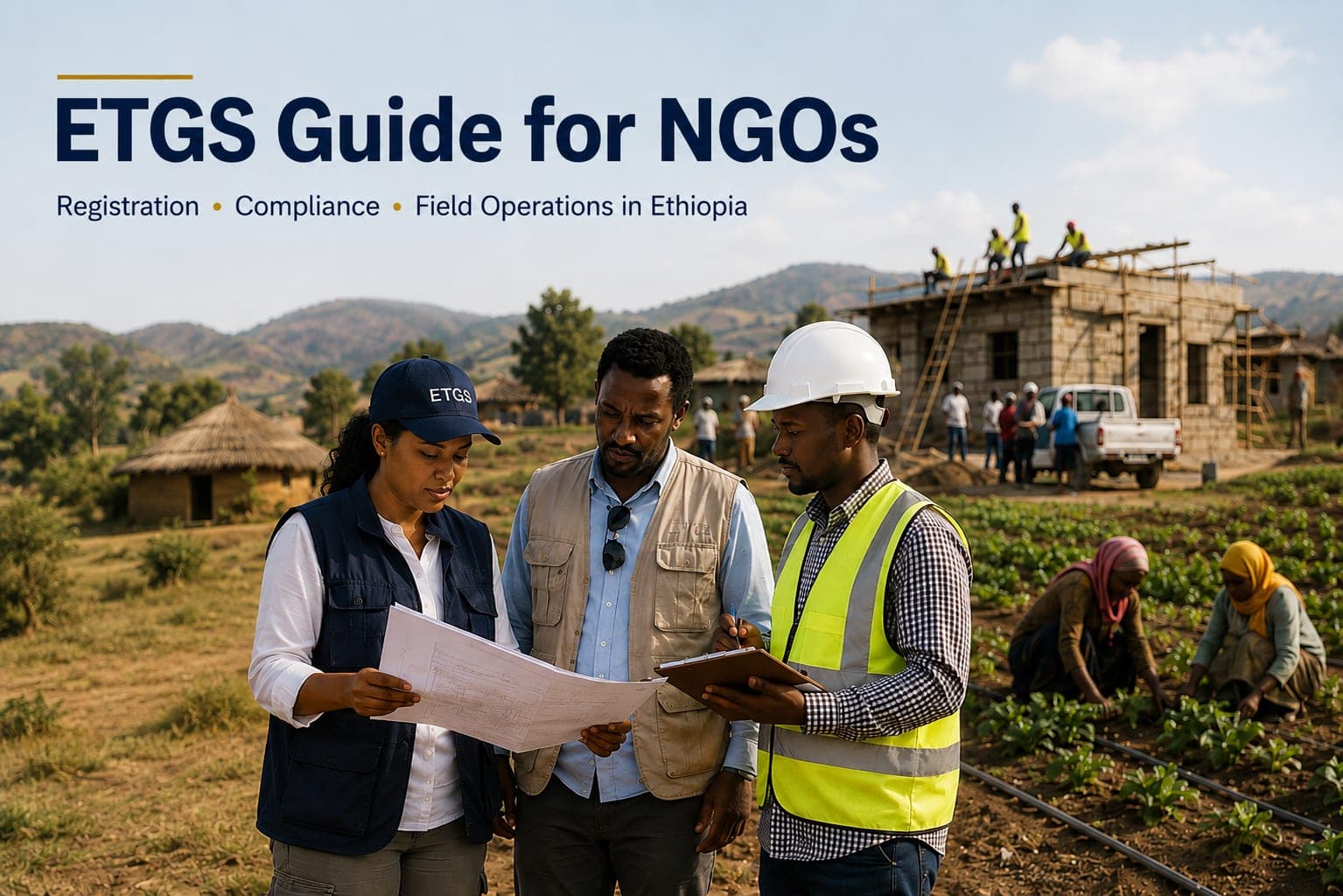
# How to Register and Operate an International NGO in Ethiopia: 2026 Guide
Practical guidance for international NGOs, foundations and nonprofit organizations establishing or expanding operations in Ethiopia.
Ethiopia remains an important operating market for international NGOs working in agriculture, health, education, water, humanitarian response, livelihoods and development.
But establishing an NGO operation in Ethiopia involves much more than obtaining a registration certificate.
An international organization entering the country must coordinate legal registration, authenticated corporate documents, government relationships, banking, taxation, employment, immigration, procurement and ongoing compliance.
The process is manageable when these steps are planned in the right sequence. Problems usually begin when registration is treated as a standalone legal exercise and operational planning starts only after the certificate has been issued.
This guide explains the practical process for establishing and operating an international NGO in Ethiopia in 2026.
1. Understand the Regulatory Framework
International NGOs operating in Ethiopia are primarily regulated under the country's civil society framework.
The main federal authority responsible for registration and oversight is the Authority for Civil Society Organizations (ACSO).
A foreign organization should separate two issues from the beginning:
Registration of the organization
and
Authorization and coordination for the projects it intends to implement.
ACSO registration establishes the organization's formal legal presence in Ethiopia.
Depending on the sector, location and nature of the project, additional coordination may later be required with relevant federal ministries, regional authorities or sector agencies.
A preliminary Memorandum of Understanding with the Ministry of Foreign Affairs or a sector ministry should not be treated as a universal prerequisite for submitting a foreign-organization registration application to ACSO.
Sector-specific agreements may still become necessary for implementation.
2. Prepare the Foreign Organization Documents
The first major workstream normally starts outside Ethiopia.
The organization must demonstrate that it legally exists in its home jurisdiction and that it has formally authorized the establishment of operations in Ethiopia.
The registration package may include documents such as:
- Certificate of incorporation or equivalent proof of registration
- Constitution, bylaws or articles of association
- Board resolution or formal decision authorizing operations in Ethiopia
- Power of Attorney for the authorized representative
- Identification documents for the representative
- Evidence concerning the organization's legal standing and previous activities
- Proposed Ethiopia work plan
- Other supporting documents required under the applicable ACSO process
The exact package should be checked before authentication begins.
This is important because correcting a document after notarization and diplomatic authentication may require repeating part of the process.
3. Review the Power of Attorney Carefully
The Power of Attorney is one of the most important documents in the establishment process.
The representative may need authority to deal with several institutions and complete several establishment activities.
Depending on the planned structure, this may include authority to:
- Represent the organization before ACSO
- Submit and collect documents
- Communicate with Ethiopian government institutions
- Sign administrative documents
- Complete tax registration
- Establish banking arrangements
- Manage other establishment procedures
The NGO should determine the required authority before authenticating the document.
A narrowly drafted Power of Attorney can create unnecessary delays later.
4. Authenticate the Required Foreign Documents
Documents issued outside Ethiopia generally need to follow the applicable authentication or legalization process before they can be used before Ethiopian authorities.
The exact route depends on factors including:
- Country of incorporation
- Type of document
- Diplomatic arrangements
- Ethiopian requirements in force at the time of filing
Organizations should therefore verify the required authentication chain before processing their documents.
The safest approach is straightforward:
Review the complete Ethiopia registration package before authentication begins.
An error found beforehand may take minutes to correct.
The same error found after several stages of legalization may delay the process significantly.
5. Prepare an Ethiopia-Specific Work Plan
Registration is not based only on proving that the NGO legally exists abroad.
The organization also needs to explain what it intends to do in Ethiopia.
A strong Ethiopia work plan should address matters such as:
- Program objectives
- Proposed activities
- Geographic areas of operation
- Intended beneficiaries
- Implementation structure
- Staffing requirements
- Expected outcomes
- Budget
- Monitoring and reporting
- Project duration
Foreign NGOs should avoid submitting a generic global presentation in place of an Ethiopia operating plan.
The document should clearly answer:
What will the organization do in Ethiopia, where will it operate and how will the program be implemented?
6. Map Government and Sector Stakeholders
NGOs should not assume that ACSO registration completes every government requirement associated with their projects.
Depending on the program, additional government coordination may be required.
For example:
- Agricultural projects may involve agriculture authorities
- Health programs may require engagement with health authorities
- Education projects may require education-sector coordination
- Water projects may involve federal or regional water institutions
- Regional programs may require coordination with regional governments
The exact requirements depend on the project.
This is why organizations should prepare a government stakeholder map during establishment.
Registration, project agreements and implementation approvals should be managed as related but separate workstreams.
7. Submit the ACSO Registration Application
Once the required documentation is complete and properly authenticated, the foreign organization can submit its registration application through its authorized representative.
The registration process is based on the formal application and required supporting documentation rather than on a universal pre-registration ministry MOU.
The practical timeline depends heavily on the quality and completeness of the submission.
Common causes of delay include:
- Inconsistent corporate documents
- Incomplete authentication
- Unclear authority granted to the representative
- Missing supporting documents
- Insufficiently detailed work plans
- Slow follow-up after requests for corrections or clarification
The total establishment timeline should therefore not be calculated only from the day the file reaches ACSO.
Preparation before submission is often the most important stage.
8. Establish Financial and Compliance Controls
International NGOs need a clear system for financial administration from the beginning of operations.
This includes defining how expenses are approved, documented, recorded and reported.
The organization should establish procedures for matters such as:
- Payroll
- Supplier payments
- Supporting documentation
- Internal approvals
- Donor reporting
- Local accounting
- Audit preparation
- Financial controls
This should be treated as part of operational setup, not simply as a year-end accounting requirement.
The objective is to create a system in which project spending can be clearly documented and reconciled against both Ethiopian requirements and donor expectations.
9. Establish Tax and Accounting Systems
Once registered, the organization needs an appropriate tax and accounting structure.
This may include obtaining a Tax Identification Number (TIN) and establishing procedures for applicable tax and reporting obligations.
Even nonprofit organizations may have obligations connected to:
- Employee payroll tax
- Withholding tax
- Supplier payments
- Accounting records
- Financial reporting
- Statutory audits
Organizations should establish these systems before significant local expenditure begins.
This becomes particularly important where international donor funds must later be reconciled against Ethiopian records and supporting documents.
10. Open Local and Foreign Currency Bank Accounts
International NGOs generally need a banking structure that allows international funding to enter Ethiopia while supporting local expenditure.
This commonly involves:
- Ethiopian Birr accounts
- Foreign currency accounts
Foreign NGOs can maintain foreign currency accounts with authorized Ethiopian banks, subject to the current foreign-exchange, banking and reporting framework.
Ethiopia's foreign-exchange system has undergone significant reforms in recent years, so organizations should confirm the current account-opening and documentation requirements directly with an authorized bank before transferring funds.
Banking should be planned early.
The NGO should understand how donor or headquarters funds will move into Ethiopia before major project expenses become due.
11. Build the Local Team
Once operational establishment is underway, the NGO can begin building its Ethiopian team.
Early positions may include:
- Country Representative or Country Director
- Project Manager
- Finance and Administration staff
- Program Officers
- Procurement and Logistics staff
- Drivers
- Field personnel
Employment arrangements need to comply with applicable Ethiopian labor, payroll and tax requirements.
International organizations should also decide which functions need to be internal from day one.
Recruitment, payroll, logistics, procurement and supplier management may sometimes be supported externally while the permanent local structure is being built.
12. Arrange Work and Residence Authorization for Foreign Staff
Foreign personnel should not assume that entry into Ethiopia automatically authorizes them to work.
Expatriate employees generally require the appropriate employment and residence authorization for their position.
The exact process depends on factors such as:
- The organization's registration status
- The employee's role
- The nature of the assignment
- Current immigration and employment requirements
Organizations intending to deploy foreign managers or technical personnel should begin this process early.
This is especially important where a foreign employee will formally represent the NGO or handle contracts, banking or government relationships.
13. Establish Procurement and Supplier Controls
Registration gives an organization legal standing.
It does not create a functioning local supply chain.
A newly established NGO may quickly need to procure:
- Vehicles
- Office equipment
- Transportation
- Construction services
- Field supplies
- Professional services
- Communications equipment
- Warehousing
- Accommodation
- Project materials
Supplier selection should involve more than collecting quotations.
International organizations should verify matters such as:
- Business registration
- Relevant licenses
- Ownership and authorized signatories
- Physical operations
- Previous projects
- References
- Delivery capacity
- Financial capacity where relevant
Supplier and contractor verification is particularly important where procurement is managed from headquarters by people with limited familiarity with the Ethiopian market.
14. Establish Operational Controls
Once implementation begins, the NGO needs systems to manage what is actually happening on the ground.
Depending on the project, this can include:
- Procurement tracking
- Contractor supervision
- Logistics coordination
- Vehicle management
- Regional travel
- Staff management
- Inventory control
- Site inspections
- Project reporting
- Government follow-up
- Financial documentation
The challenge becomes greater for programs outside Addis Ababa.
Headquarters may see invoices, reports and contracts remotely, but this does not automatically verify what has actually been delivered at a project site.
Responsibility for local verification and execution should therefore be clear before implementation starts.
15. Maintain Ongoing Compliance
NGO registration is not a one-time exercise.
Foreign organizations need to maintain regulatory, financial and administrative compliance throughout their operation.
Depending on the organization and project, this can include:
- Annual reporting
- Financial reporting
- Statutory audits
- Tax compliance
- Employment records
- Updating organizational information
- Reporting changes to representatives
- Project reporting
- Sector-specific reporting
- Maintaining supporting documentation
Responsibility for these items should be assigned from the beginning.
An organization that waits until it needs a renewal, bank transaction or government approval can quickly find itself dealing with an avoidable compliance problem.
# Common Mistakes International NGOs Make
Treating a Ministry MOU as the First Mandatory Registration Step
A preliminary MOU with a federal ministry is not a universal ACSO registration prerequisite.
Registration requirements and sector-specific implementation arrangements should be mapped separately.
Starting Authentication Before Reviewing the Entire File
A small error in a board resolution or Power of Attorney becomes much harder to correct after authentication.
Using a Generic Global Program Description
Ethiopian authorities need an Ethiopia-specific operating plan.
Waiting Until Registration Is Complete to Think About Banking
Fund-flow arrangements should be understood before project financing needs to enter Ethiopia.
Recruiting Before Payroll and Finance Systems Exist
Employment, accounting and tax procedures should be ready when the first employees start.
Selecting Suppliers Only by Price
A low quotation provides little protection if the supplier cannot actually deliver.
Managing the Entire Ethiopia Operation From Headquarters
Some issues cannot be solved through another email.
Documents need follow-up, suppliers need verification, project locations need inspection and government processes often need local coordination.
# Registration Is Only the Beginning
The objective for an international NGO should not simply be:
"We are registered in Ethiopia."
The real objective is:
"We are operational in Ethiopia."
That means the organization can receive and manage funding, employ staff, work with the relevant authorities, procure goods and services, supervise suppliers, operate in project locations and meet its regulatory and donor obligations.
For an international NGO entering Ethiopia, registration is therefore only one part of establishment.
The operating structure built around that registration will ultimately determine how effectively the organization can deliver its programs.
# Setting Up or Expanding an NGO Operation in Ethiopia?
ETGS supports international NGOs, foundations and development organizations from establishment through implementation.
Our support can include:
- Registration and regulatory coordination
- Document preparation and follow-up
- Government and sector coordination
- Recruitment and payroll support
- Supplier and contractor verification
- Procurement support
- Logistics coordination
- Office and operational setup
- Project-site support
- Contractor supervision
- Operational reporting
- Ongoing local coordination
ETGS provides international organizations with a single accountable execution point for their Ethiopian operations, connecting headquarters requirements with practical implementation on the ground.
Planning to establish, expand or implement a project in Ethiopia?
Talk to ETGS.
Questions this raises
- What is the required ratio of project spending to administrative costs for INGOs in Ethiopia?
- The Authority for Civil Society Organizations (ACSO) dictates a strict mandatory ratio limiting administrative overhead compared to operational project spending. The exact threshold is set by ACSO directives and must be confirmed prior to financial planning.
- How long does it take to process an NGO registration application in Ethiopia?
- The timeline depends on document authentication speeds at the Ministry of Foreign Affairs and the final review by the Authority for Civil Society Organizations. Processing durations vary based on institutional backlogs and must be verified at the time of application.
- Do foreign NGOs need a minimum initial capital deposit in Ethiopia?
- The Authority for Civil Society Organizations requires proof of initial funding to support the proposed projects, governed by current regulatory directives. The required capital must be confirmed with ACSO during the preliminary application phase.
- Can an international NGO open a foreign currency bank account in Ethiopia?
- Opening a foreign currency account requires explicit approval from the National Bank of Ethiopia. The central bank sets specific guidelines for foreign exchange retention and utilization by civil society organizations, which must be verified through local banking partners.
Related on this site
If this is the decision in front of you, twenty minutes will tell us both whether we can help.
Request astrategy callOne essay a month